All source code are from Redis 7
redisDb #
How does Redis hold all data?
How does Redis search keys fast?
It takes advantage of dict, the same struct for Redis hash. Same as sds, dict is a highly used struct.
The following struct redisDb is used to store all keys and values.
// server.h
/* Redis database representation. There are multiple databases identified
 * by integers from 0 (the default database) up to the max configured
 * database. The database number is the 'id' field in the structure. */
typedef struct redisDb {
    dict *dict;                 /* The keyspace for this DB */
    dict *expires;              /* Timeout of keys with a timeout set */
    dict *blocking_keys;        /* Keys with clients waiting for data (BLPOP)*/
    dict *ready_keys;           /* Blocked keys that received a PUSH */
    dict *watched_keys;         /* WATCHED keys for MULTI/EXEC CAS */
    int id;                     /* Database ID */
    long long avg_ttl;          /* Average TTL, just for stats */
    unsigned long expires_cursor; /* Cursor of the active expire cycle. */
    list *defrag_later;         /* List of key names to attempt to defrag one by one, gradually. */
    clusterSlotToKeyMapping *slots_to_keys; /* Array of slots to keys. Only used in cluster mode (db 0). */
} redisDb;
redisObject #
How does Redis know value’s type in redisDb?
For example, after the following set command executed,
>redis-cli set str_key str_value
the redisDb should look like this
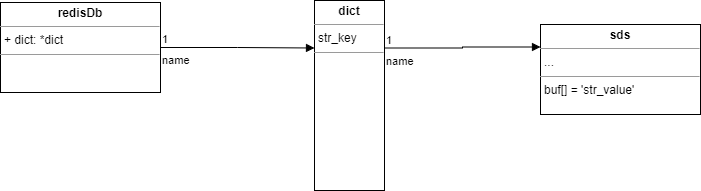
but why does Redis know that the following command cannot be processed?
>redis-cli lpush str_key another_value
The answer is Reids wraps any value with redisObject, redisObject knows value’s exact type.
so after the first command executes, the redisDb may looks like this(not exactly, this will be described in Redis String):

// server.h
typedef struct redisObject {
    unsigned type:4;
    unsigned encoding:4;
    unsigned lru:LRU_BITS; /* LRU time (relative to global lru_clock) or
                            * LFU data (least significant 8 bits frequency
                            * and most significant 16 bits access time). */
    int refcount;
    void *ptr;
} robj;
Object type and encoding type #
Redis has five object types, each type supports a set of operations.
// server.h
#define OBJ_STRING 0    /* String object. */
#define OBJ_LIST 1      /* List object. */
#define OBJ_SET 2       /* Set object. */
#define OBJ_ZSET 3      /* Sorted set object. */
#define OBJ_HASH 4      /* Hash object. */
Each object type may be represented by diffrent data structures, called encoding type, Redis has the following encoding types:
// server.h
#define OBJ_ENCODING_RAW 0     /* Raw representation */
#define OBJ_ENCODING_INT 1     /* Encoded as integer */
#define OBJ_ENCODING_HT 2      /* Encoded as hash table */
#define OBJ_ENCODING_ZIPMAP 3  /* No longer used: old hash encoding. */
#define OBJ_ENCODING_LINKEDLIST 4 /* No longer used: old list encoding. */
#define OBJ_ENCODING_ZIPLIST 5 /* No longer used: old list/hash/zset encoding. */
#define OBJ_ENCODING_INTSET 6  /* Encoded as intset */
#define OBJ_ENCODING_SKIPLIST 7  /* Encoded as skiplist */
#define OBJ_ENCODING_EMBSTR 8  /* Embedded sds string encoding */
#define OBJ_ENCODING_QUICKLIST 9 /* Encoded as linked list of listpacks */
#define OBJ_ENCODING_STREAM 10 /* Encoded as a radix tree of listpacks */
#define OBJ_ENCODING_LISTPACK 11 /* Encoded as a listpack */